This is the blog of Satpuda Foundation and Nature Conservation Society of Amravati. We work to protect wildlife and the forests of the Satpuda Tiger
Landscape of central India. Even though most of us are city-dwellers. This blog is about how we urbanites can help to stem the tide and save our national animal from extinction. And in turn, save ourselves.
This year our Conservation Officers initiated seed banks in some villages (see our Quarterly Report). One such seed bank is in Sawra, the village near Pench TR that I visit regularly. The hub of most progressive activity in the village is the government school, thanks to an admirable set of teachers and headmaster who team up with us to bring about positive and "green" change in the village.
Saplings were grown from the collected seeds by the school children, under the supervision of the teachers.
Above: Student Sailesh and SF's Anoop Awasthi show me the saplings
Above: Sailesh poses with a "bel" (wood-apple) sapling gifted to me by the school. Bel fruit juice is one of the most refreshing drinks one can have in summer, and it has many medicinal properties.
Above, below: Saplings were not randomly distributed but given only to villagers who were willing to look after them properly. A wise policy that has led to high survival rate of the plants this year. They have been fenced for their protection from grazing animals.
Mumbai volunteer Kirti Chavan was in Pench recently for the IT programme that he initiated in February. Read the earlier posts here and here.
The programme was launched in the school at Sawra on a pilot basis and Kirti makes regular visits to monitor the progress. These are some of the pictures he took at the school.
Above: A regular non-human visitor to the school, the non-venomous Buff striped Keelback
Above, below: Happy kids at school. "Here children really love school," Kirti says. "They come early, leave late, and you'll find some even on sundays arranging library books or watering the plants. They are involved in everything that the school does."
Above: Prayer time
Above, below: Group photos with and without Kirti
Above: Three children made this clay Ganpati idol under the supervision of schoolteacher Sachin Ambadkar.
Above: With their new enthusiasm for computers, the kids have even depicted Ganpati using a laptop!
Qualification: Any Graduate /PG, preferably M.Sc Environmental Science, B.Ed.
The Education Officer (EO) will be working from SF's head office at Nagpur. EO will be responsible for implementing the education programmes in Nagpur (Kids for Tigers) and Pench Tiger Reserve. He/She should have knowledge of wildlife issues and should be good in English, Hindi and Marathi languages.
The candidate must have own bike/motorcycle to travel in the city. The duration of the assignment is one year and you may apply next year to continue. The honorarium of Rs.8000/month will be provided.
Qualification: Any Graduate /PG, preferably M.Sc. Environmental Science, Master of Social work
The PM/PO must have knowledge of Bio-diversity conservation, Carbon capture technology, CDM project and eco-restoration operations. He/she should be good in extensive field work like plantations, soil and moisture conservation works, mapping, planning, community mobilization, awareness and administration. He/she should also have knowledge of local language Hindi /Marathi as the PM/PO need to work with local communities.
The post is based at Akot in Akola district close to Melghat Tiger Reserve. SF would provide the accommodation and travel expenses to carry out the work. The honorarium of Rs.8000 to Rs.12,000/month will be provided (Depending upon qualification and experience).
3) Research Officer (RO)
Qualification: Post Graduate in Biology with experience of handling field research programmes or preferably M. Sc. wildlife Conservation/ Management.
The RO must have the knowledge of methodologies of conducting wildlife research programmes in the field.The RO should specially know mapping of wild animal locations, radiotelemetry, camera trapping other capturing-recapturing techniques, GIS based monitoring etc.The candidate is required to know Protected area management issues like Impacts on wildlife habitats, Survey of human-animal conflicts, Threat identification surveys, Management oriented research projects, Conservation Plans and Management Plans
The post is based at Nagpur and will have to operate in and around Tiger Reserves and PAs in Satpuda Landscape in central India. Salary Rs.10,000 to 12,000/month and negotiable. (Depending upon qualification and experience).
4) Conservation Officer (Tadoba Project)-01
Conservation Officer will have to work from the SF’s field office at Moharli near Tadoba Andhari Tiger Reserve and handle community conservation works in the villages situated in the buffer villages of TATR. CO will be responsible for executing the wildlife conservation and community based conservation programmes.
The candidate should have the motor-cycle driving licence and experience of field work in forest areas. The duration of the assignment is one year, with a provision for a further two years’ extension. The honorarium of Rs.8000/month (depends upon qualification and field experience).
Please send your CVs and applications at satpuda@gmail.com as early as possible.
The Landscape Monitoring Unit (LMU) was busy during the quarter conducting rapid assessments of projects which can prove detrimental to the Satpuda landscape and specially the wildlife corridors connecting the tiger reserves in Satpuda.
The LMU visited the following sites and documented the threats to the tiger landscape in central India. Later LMUdid advocacy to arrest the destruction with the help of partners and individuals within and outside Government.
1. Survey conducted of airstrip coming up just 12 km away from Pench buffer
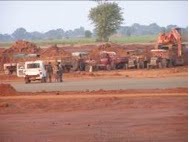
The LMU noticed the work of a two-km air strip project worth Rs 4.56 crore close to National Highway 7 near Pench National Park and Tiger Reserve, Madhya Pradesh.
The Public Works Department (PWD) in Seoni district is engaged in construction of the site near Suktara village in Seoni district. The project would be detrimental to wildlife of Pench. The LMU has done an assessment and gathered the relevant documents of the project.
Above: The airstrip at Suktara near Pench Tiger Reserve
The project is hardly 12 kms from the Karmazari gate of Pench. Earlier, the airstrip was proposed near Kanha Tiger Reserve in Mandla district. However, apprehending opposition, the project proponent decided to construct it near Pench. Over 100,000 tourists, including 10,000 foreigners, visit these parks from October 1 to June 30. The facility has been created for these tourists.
Tenders to construct the airstrip in Suktara were floated on July 5, 2008. As the project was to be constructed on private land outside the core and buffer areas of Pench Tiger Reserve, it was unnoticed by the Pench TR administration.
However the project is located around 12 kms from Karmazari gate and 6 km from the buffer and small planes and mid-size passenger liners would be landing here.
The agency has not done any Environment Impact Assessment (EIA) before commencing the work as the land was not part of the buffer or core zone.
Having Nagpur’s Sonegaon airport close to the reserve forest, passengers have miraculously escaped with their lives several times, with planes hitting deer or wild boar. Here the airstrip is very close to the Tiger Reserve. Pench is special in being home to vultures and has provided a breeding ground for this highly-endangered species. Hits will not only kill animals but birds too.
The team found that the hoteliers who have set up luxury resorts at Pench are behind the project, eyeing foreign visitors. The LMU took up the matter with Ministry of Environment and Forests (MoEF).
2. LMU studied the impact of canal network on tiger corridor
LMU also studied a canal network being constructed by the irrigation department in the tiger corridors between Pench and adjoining tiger corridors, which is proving to be detrimental for wildlife in central India.
The network has fragmented the continuity of wildlife corridors. The LMU has written a letter to the Union Minister of Environment and Forests and pointed out its impact on the tiger corridor in central India, suggesting mitigation measures to be taken for saving the wild animals and specially tigers.
Above: Canal network creating barrier in safe dispersal and movements of animals in the tiger corridor
LMU listed the irrigation projects that have affected the tiger corridors through their canals. The wildlife corridor between Melghat near Amravati and Pench Tiger Reserve near Nagpur have been affected by the Upper Wardha Irrigation Project. The Pench National Park-Tadoba Andhari Tiger Reserve stretch is affected by the Gosekhurd irrigation project.
The corridor between Pench and Nagzira sanctuary is affected by Pench canals, the Pench-Nagzira corridor is affected by the Bawanthadi canal. The Nagzira-Navegaon corridor is affected by the Itiadoh-Zasinagar-Nawegaon canal and the Tadoba-Andhari-Navegaon corridor has been affected by Ghodajhari canal.
After listing the irrigation canals and corridors, Satpuda Foundation also suggested the methodology for designing mitigation measures.
3. Kishor Rithe on panel to assess the impact of proposed thermal power project on Nagzira tigers
The Government of India and the State appointed SF founder and president Kishor Rithe and four others to provide opinions on the probable impacts of the proposed thermal power project near Nagzira WLS. The issue was raised by NGOs objecting to the power project so close to Nagzira WLS, which is also a proposed Tiger Reserve.
The 3 units have been proposed at Tiroda at 163.84 hectare forest land which is proposed to be diverted for Adani Power Maharashtra Limited (APML) for its power plant.
National Tiger Conservation Authority of the Ministry of Environment and Forests (MoEF), had already expressed concern over diversion of the forest land as it forms the corridor between Pench Tiger Reserve near Nagpur and Nagzira Wildlife Sanctuary near Gondia.
Kishor Rithe was asked to represent NTCA. On the direction of Additional Director General of Forests (forest conservation), the Chief Wildlife Warden of Maharashtra constituted a committee under his chairmanship.
The mandate of the committee was to study likely impact on the wildlife of Nagzira WLS and also the corridor between Pench Tiger Reserve - Nagzira Wildlife Sanctuary to Tadoba-Andhari Tiger Reserve (TATR). The panel visited the site and submitted its report to the Government of India.
As always all our teams in the field (Conservation Officers and Field Officers) have been hectically busy with a wide range of activities to preserve and improve the tiger landscape: water conservation, tree plantation, clean-up drives, fire-fighting, patrolling with forest officers, education of local communities, vocational training and employment for villagers to reduce their dependence on the forest.
Posting the whole quarterly report is not possible as there are more than a hundred snapshots and items. I'm posting just a few images and activities here to show the scope and range of our work. The names of our officers are listed at the end of the report. Kudos to all of them for their hard work and dedication.
I'll post separate updates soon on our Landscape Monitoring Unit and Melghat Eco-restoration project.
Fire-fighting
Tadoba-Andhari Tiger Reserve
Above: At Dewada
Above: Firefighting at Adegaon
Our team in the Satpuda TR also helped put out a fire.
Pench Tiger Reserve - Firefighting at Sawra with villagers and Ranger:
We had asked Mr Kharabe, RFO (Territorial) Deolapar to participate in the inauguration of our sewing and embroidery training programme in Sawra. On his way to join us, he saw a fire in the forest around 2 kms from the village. He came to Sawra and asked for assistance. Around 10 school children, 2 adult villagers, teacher Manoj Mankar, Anoop Awasthi and Dilip Lanjewar responded. The whole team fought the fire for 1 1/2 hours. Mr Kharabe was so pleased with the response that he gave Rs 500 to the children. The team decided to purchase a volleyball and a
football for the children's use. Mr Kharabe also promised his assistance to any of our future programmes. He came back to the village and gave a talk on forests, the benefits of forests to villager and the need to protect them.
Satpuda TR: On April 19 a fire was started by villagers in the forest near Birjikhapa to facilitate their collection of mahua flowers. Our Conservation Officer Ashfaq was having lunch with the Deputy Ranger at Nayakheda when they saw smoke. Seven Forest Department staff and Ashfaq then rushed to the spot to fight the fire which, by then, had spread and was threatening to damage even the village. Some of the villagers also joined in the fire-fighting.
Because forest fires are such a menace in summer, we are working to educate villagers about the harmful effects of forest fires and the need to assist the Forest Department in containing them. We have conducted awareness programmes in 4 villages in April: Parraspani, Raikheda, Nandner and Dhargaon in the Matkuli cluster. In May we organized programmes in 11 villages to educate villagers about forest fires - how carelessness can cause fires, other reasons for fires, the harm caused to nature and wildlife as well as humans, and also how to fight fire. In 2 villages, Nayakheda and Birjikhapa, forest guards joined us in the programme.
Kanha NP: In April at a programme at Batwar, our team educated villagers about the many harmful effects of forest fires and the need to help the Forest Department in fighting them.
-->Anti-poaching patrols:
Pench: Joined hands with Forest Department on anti-poaching patrols on several occasions. On May 1 and 20, our Field Assistant Bandu Uikey volunteered in patrols around waterholes in West Pench, with forest guards Munde and Rathore. On June 6 and 13, he joined patrols at Ghatpendari in checking waterholes for signs of poaching and poisoning, and to clean them of litter. Water conservation
Above: Cleaning soak pit at Adegaon, Tadoba-Andhari TR, May 2010
Above: Cleaning waterhole at Sitarapeth, TATR, June
Above: Cleaning soak pit at Kondegaon, TATR, July
Above: Constructing waterhole at Khamma, Pench TR, May
Above: Soak pit at Turia, Pench, June
Above: Shramdaan/voluntary work at Ghoti, Pench, June. Creating a waterhole.
Above: Waterhole at Chapri, Kanha National Park, May
Above: Cleaning waterhole at Chapri, Kanha NP, May
Seed banks and tree plantation
Above, below: Seed collection, Pench, June
Above: Seed collection at Dewada, TATR, June
Above: Free distribution of seeds at Chapri, Kanha NP, June. Ajeewika (an MP government agency set up for rural livelihood development) and the Agriculture Department, invited SF to distribute free seeds to poor farmers in Chapri where our centre is located. The seeds are corn, rice and tur.
Above: Digging pit for plantation at Patpara, Kanha NP, June
Above: Plantation preparation at Ghatpendri, Pench, June
Above: Digging pits for plantation at Adegaon, TATR, July
Above: Plantation at Turia, Pench June
Above: Plantation at Ghatpendri, Pench, July
Above: Distribution of saplings at Chapri, Kanha NP, July. Under an Ajeewika scheme, villagers are given Rs 2 to dig one pit and Re 1 to plant one sapling.
Above: Plantation at Chapri, Kanha NP, July
Above: Sapling distribution at Bindakheda, Satpuda TR, July
Above: Tree plantation by D P Tiwari, Biodiversity Board, at Matkuli, Satpuda TR, July
Rainwater harvesting
Ajeewika has launched a programme to harvest rainwater in all the 10 villages that we work in in Kanha. The work of monitoring progress and follow-up has been entrusted to us. Work on rainwater structures is going on in the schools in all our villages, and four have been completed.
Vocational training
Driving - course funded by Hemendra Kothari Foundation, at Moharli, Tadoba-Andhari TR
Sewing
Above: Malvi, at Matkuli, Bori-Satpuda TR, with her sewing machine. She was trained in sewing through SF.
Above: The sewing group at Sawra, Pench, that was trained through Pratham's skill centre facilitated by SF. Here they are displaying re-usable shopping bags they've made after the course. The bags will be available for sale in Mumbai (through the Mumbai-based volunteers) and one or two other cities when they are ready.
Mobile Health Unit
Pench - medical camps in 24 villages, 694 villagers treated
Above: Setting up the Mobile Health camp at Narhar, Pench, July
Above: MHU at Turiya, Pench TR, May
Above: MHU at Dewada, Tadoba-Andhari TR, June
Above: MHU at Jamni, Tadoba-Andhari TR, May
Above: MHU at Palasgaon, Tadoba-Andhari TR, July
Above: MHU at Wanera, Pench TR, July - Conservation Officer Anoop Awasthi and a volunteer dispense medicines from the ambulance
Above: Forest guard Mr Wadke with our MHU team at Piparheti, Tadoba-Andhari TR, June
Clean-up drives
Above: Anti-plastic campaign at Bhamdeli, Tadoba-Andhari TR, May. Anti-plastic drives were conducted in 3 villages.
Composting
Forest officials in the buffer area villages around Kanha NP have recently introduced a scheme for setting up vermi-compost units in villages. Mr Solanki, RFO Khatiya, asked SF Conservation Officer Amit Awasthi to assist in spreading awareness about this scheme in our project villages.
Above: Awareness programme on vermi-composting at Manegaon, Kanha NP, May
Above: Compost pit being dug at Chapri, Kanha NP, July
Above: Compost pit at Sauthiya, Kanha NP, July
Nature education
Above: Nature trail at Chapri, Kanha, June.
There have been several nature and birding trails organized by our Tadoba Conservation Officer Bandu Kumare as well. Bandu was a Park guide earlier and uses his knowledge to enthuse young people about the biodiversity of the region.
Above: Nature game at Sitarampeth, Tadoba-Andhari TR, July
Above: Awareness programme on tree plantation at Matkuli, Bori-Satpuda TR
Above: Environment education at Aamajhari, Pench, July
Above: Rally on conservation at Chapri, Kanha NP, July
Above: Environment education programme, Dewada, Tadoba-Andhari, July
Above: Film show, Kondegaon, Tadoba-Andhari, July
Water pots for birds
Above: SF team making water pots for birds, Nayakheda, Satuda TR, May
Above: Self-Help Group at Nayakheda putting up water pots for birds, Satpuda TR, May. Water pots were placed for birds in 14 villages.
Above: Children putting up water pots for birds at Khamna, Pench, May
Pench: Education van programme in 7 villages, attended by 292 people
Clothes distribution
Above: Clothes distribution at Ghoti after voluntary work (shramdaan) - Pench, June. Under our clothes-for-work scheme, garments are not handed out indiscriminately but are distributed only after villagers have done some conservation work for the community.
Placements Some of the young villagers who have found good jobs through our Employment Cell.
Above: Placement of Ramdayal at Maheshwari Resort, Chapri, Kanha, May
Above: Placement of Harichand at Maheshwari Resort, Chapri, Kanha, May
Above: Placement of Choubhelal at Maheshwari Resort, Chapri, Kanha, May
Above: Abhiman Choukey of Sitarampeth (Tadoba) placed with Economic Explosives, Nagpur, May
Above: Conservation Officer (Tadoba-Andhari TR) Bandu Kumare interacting with youths in Dewada about placement and ITI courses, May
Above: Placement of Devsingh Sayyam at Chapri, Kanha, June
Above: Placement of Ashok Uikey at a resort, Kanha, July
Above: Placement of Nathulal Maravi of Chapri at Tigerwoods resort, Kanha, July
Events
Above: Function to celebrate International Biodiversity Day at Nayakheda, Bori-Satpuda TR, May
Above: Distributing certificates to successful candidates of four-wheeler training programme funded by Hemendra Kothari Foundation, Moharli, Tadoba-Andhari TR, May
Above: Dignitaries address villagers at Nayakheda on World Environment Day, Bori-Satpuda, June. The programme was funded by the MP Biodiversity Board which in turn had received funds from UNDP for celebrating this day in different places in the state. SF Conservation Officer Ashfaq Arbi, Mr Abdullah Khan (Ranger, Matkuli), Ms Aarti Arjun Palliya (President, Janpath Panchayat, Pipariya), Mr Uday Raj Singh (CEO, Janpath Panchayat, Piparaya), Mr Azhar Siddique (Dy Ranger, Jhiriya) addressed about 180 villagers from Nayakheda, Dhargaon, Anjandana, Nandkot, Mongra and Naikheda. The speakers talked about nature and biodiversity, the need for conservation and also plantation of saplings.
Above: Awareness on plantation and better farming techniques, at Manegaon, Kanha. We conducted programmes in 6 villages in partnership with Ajeewika, an MP government agency set up for rural livelihood development. The programmes taught farmers how to select appropriate seeds, preparing soil and fields for farming, and techniques of transplanting saplings. In the picture above, Mr S P Jain, SDO, Forest Department, speaks to the villagers.
Above: Conservation Officer Amit Awasthi giving information on better farming techniques at Kuthwahi, Kanha - June
Above: Biodiversity workshop at Ashramshala at Matkuli, Bori-Satpuda, July
Above: Certificate distribution through CEDMAP, Bhopal, to womens' Self-Help Group at Ec0-centre, Matkuli, Bori-Satpuda, July
Pench: Mowgli Utsav 2010 in Turiya:
-->
Every year, the MP Government organizes a festival for school children called "Mowgli Utsav" to spread awareness about wildlife and nature. Children and school children are selected from each Zillah of MP to participate in the 3-day programme. On April 9 our Conservation Officer Anoop Awasthi led the participating school children to the village Aamajhari to show them our activities and also to explain about village life and their link to the surrounding bio-diversity. Aamajhari is around 5 km from the Turia entry gate of the Pench Tiger Reserve. The children were also told about the benefits villagers gained from their proximity to the National Park, as well as the impact that humans had on the fragile eco-system. On April 10 we organized a play by the Sawra school children to convey the message that forests are the key to our water supply. The play, staged by 12 children under the guidance of one teacher, was well-received by the audience.
Ramtek MLA Ashish Jaiswal visited Sawra and saw the school and the sewing training.
Work at Kanha Community Resource Centre:
This CRC is on the model of the NCSA Community Resource Centre at Muthawa, Melghat TR. The shed housing for the gypsy and the kitchen have been repaired. Next to the mahua tree our team have dug a waterhole which is being used by chital, wild boar and birds. The fields were dug in June and ploughed in preparation for farming, and seeds have been purchased. A compost pit has been has been dug to generate organic fertilizer from organic waste at the Centre.
Follow-up on resettled village Bhagwanpur, Tadoba-Andhari:
Our team has been making regular visits to this resettled village to check the progress of the community and their needs and requirements, and also to check progress of work on a bridge on the Bhagwanpur-Naghala Road. 11 wells have been sanctioned by the Panchayat Samiti. Villagers want a separate Gram Panchayat for their village instead of being attached to the Tolewahi GP. They feel a separate GP will make them eligible for funding and other benefits under tribal development schemes.
Rescue of chitals attacked by village dogs:
Kanha, May 14: SF Conservation Officer Amit Awasthi was at the village Mocha when he heard a commotion near the forest beat box. A chital fawn was being attacked by village dogs. Amit and some villagers chased away the dogs and carried the chital to the eco-centre at Khatiya. Unfortunately it died soon after.
Tadoba, May 31:SF's Bandu Kumare was at his home in Moharli when he heard the cries of an animal and the shouts of villagers. When he ran to investigate he found a chital being attacked by three village dogs, with villagers standing around watching and doing nothing to stop them. With the help of a village youth Sanjay Kulmete (also one of the driving course trainees), and 3 employees of TRACT as well as a forest guard and one forest labourer, he pursued the dogs for 5 km. Finally the dogs gave up the chase and the chital escaped to the jungle. Shockingly, the villagers were upset at the chital's escape and accused the rescuers of depriving them of some bushmeat. However an encouraging incident is that an 8 year old village boy joined the rescue effort, saying that the chital was a spirit of the forest and should not be harmed.
SF teams in the field:
Pench:
Conservation Officer - Anoop Awasthi
Field Assistants - Bandu Uikey, Dilip Lanjewar, Niranjan Hinge